
Varanasi, Uttar Pradesh · On the Ganga
Kashi
Ancient ghats, the Ganga, and mornings that begin before sunrise.
Overview
Why travellers go.
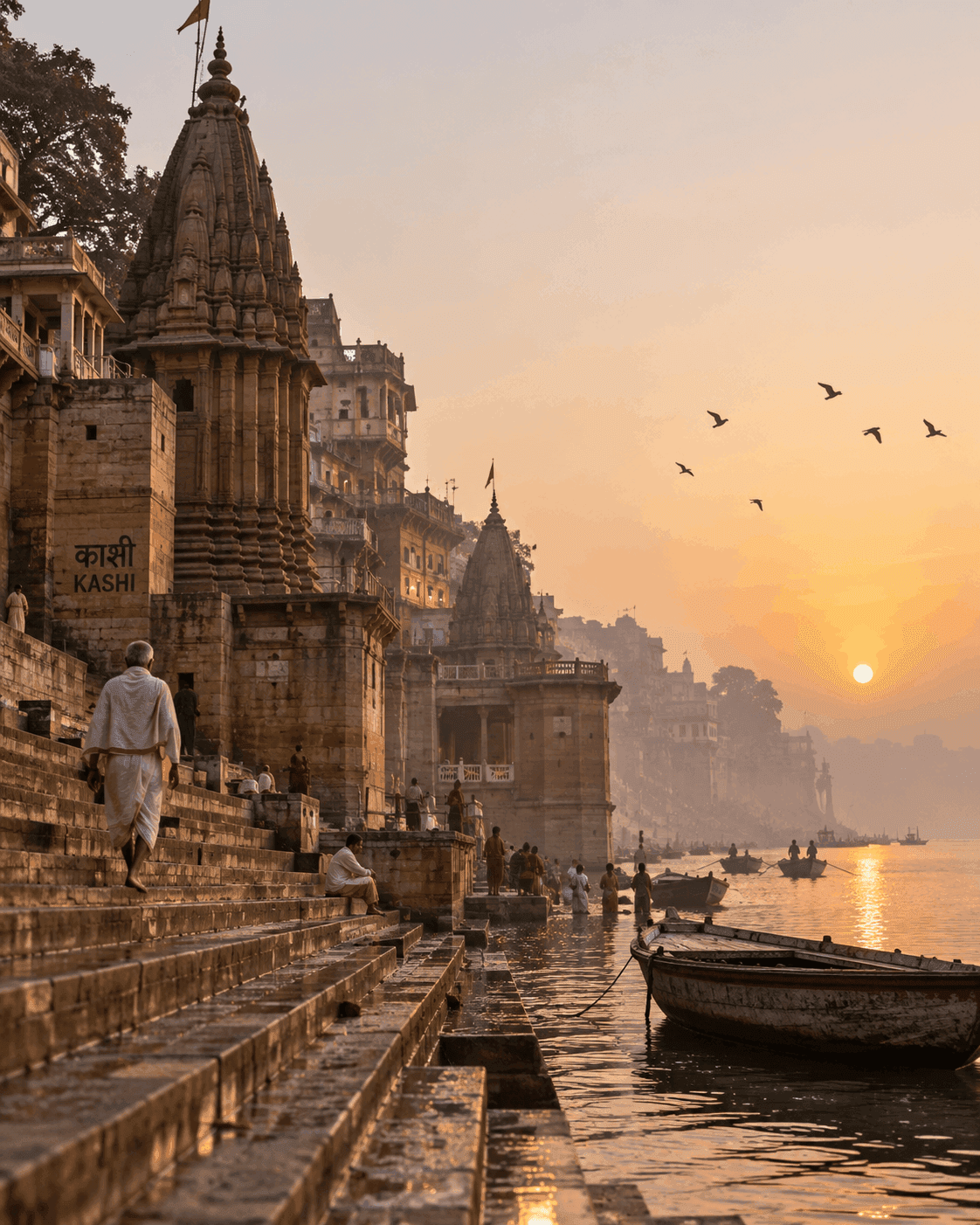
Kashi — Varanasi — is one of the oldest continuously inhabited cities in the world, and for most travellers it is also the most intense. Life and ritual run together on the ghats: cremation and celebration, prayer and commerce, all within sight of the river.
A StayNaut journey to Kashi is built around unhurried mornings — being at the water before the city wakes — and a pace that leaves room for the old city to be walked, not rushed through.
Most travellers come for darshan at Kashi Vishwanath, for a dip in the Ganga, or to perform rites for family — shraddha and pind daan are commonly arranged here. Others come simply because Kashi has drawn pilgrims for thousands of years, and they wanted to see why.
Spiritual significance
What makes Kashi sacred.
Kashi is one of the seven sacred cities (Sapta Puri) of Hindu tradition and is regarded as the abode of Shiva — believed by many to be the place where liberation (moksha) is granted. The Kashi Vishwanath Temple, housing one of the twelve Jyotirlingas, sits at the centre of this belief.
The city's 80-odd ghats line the Ganga's western bank, each with its own history and ritual purpose — from the continuous cremation fires at Manikarnika Ghat to the nightly Ganga Aarti at Dashashwamedh Ghat.
Important sites
Places worth your time.
Kashi Vishwanath Temple
The Jyotirlinga temple at the heart of Kashi, rebuilt in its present form in 1780 and connected to the ghats by the Kashi Vishwanath Corridor.
Dashashwamedh Ghat
The most central of the ghats, and the setting for the nightly Ganga Aarti performed by a line of priests at the water's edge.
Manikarnika Ghat
One of Kashi's oldest and most sacred cremation ghats, held to be a place where the cycle of rebirth is broken.
Assi Ghat
A quieter ghat at the southern end of the riverfront, popular for an early-morning boat ride as the city comes into light.
What StayNaut arranges
What a Kashi journey can include.
Kashi rewards a slower pace. Most journeys here are planned around two or three unhurried days rather than a single rushed visit — enough time for a sunrise on the river, an evening aarti, and a walk through the old city without racing the clock.
- Stays close to the ghats or in a quieter part of the city, depending on how you want your mornings to feel
- A sunrise boat ride along the ghats
- Kashi Vishwanath darshan, planned around queue times and, where relevant, VIP or Sugam Darshan options
- Evening Ganga Aarti at Dashashwamedh Ghat
- A guided walk through the old city's lanes and temples
- Arrangement of shraddha, pind daan or other family rites, where requested
Good to know
Practical considerations.
- The ghats involve a fair amount of walking on uneven stone steps — worth factoring in for elderly travellers.
- Mornings and evenings near the ghats can be crowded, particularly around the Ganga Aarti.
- Winters (November–February) are cooler and comfortable for walking; summers are hot and best avoided for long periods outdoors.
- Modest dress is expected at the ghats and inside temples.
Who this may suit
Is this the right journey for you?
- Families visiting for darshan or to perform rites for a parent or ancestor
- Travellers who want to experience Kashi at its own pace, not as a single-day stop
- Elderly travellers, with stays and routes planned around how much walking suits them
- Anyone visiting for the first time and unsure how to navigate the ghats and old city
Common questions
About the Kashi journey.
How many days should I plan for Kashi?
Two to three days is typical — enough for a sunrise boat ride, Kashi Vishwanath darshan, an evening aarti, and time to walk the old city without rushing. Longer stays suit travellers combining Kashi with Sarnath or Prayagraj.
Is Kashi manageable for elderly travellers?
Yes, with planning. The ghats involve stairs and uneven surfaces, so we factor mobility into where you stay and how each day is paced, and can arrange transport that minimises walking between key sites.
Can StayNaut arrange rites like pind daan or shraddha?
Yes. We coordinate these with priests we work with regularly in Kashi — let us know what you're looking to perform when you plan your journey, so we can prepare accordingly.
Start your journey
Your Pilgrimage.
Completely Arranged.
Tell us where you’re thinking of going, who you’re travelling with, or simply what brings you there. We’ll take it from there.
Thoughtfully planned. Personally managed.