
Sitapur district, Uttar Pradesh
Naimisharanya
An ancient forest of pilgrimage, stories and sacred tradition.
Overview
Why travellers go.
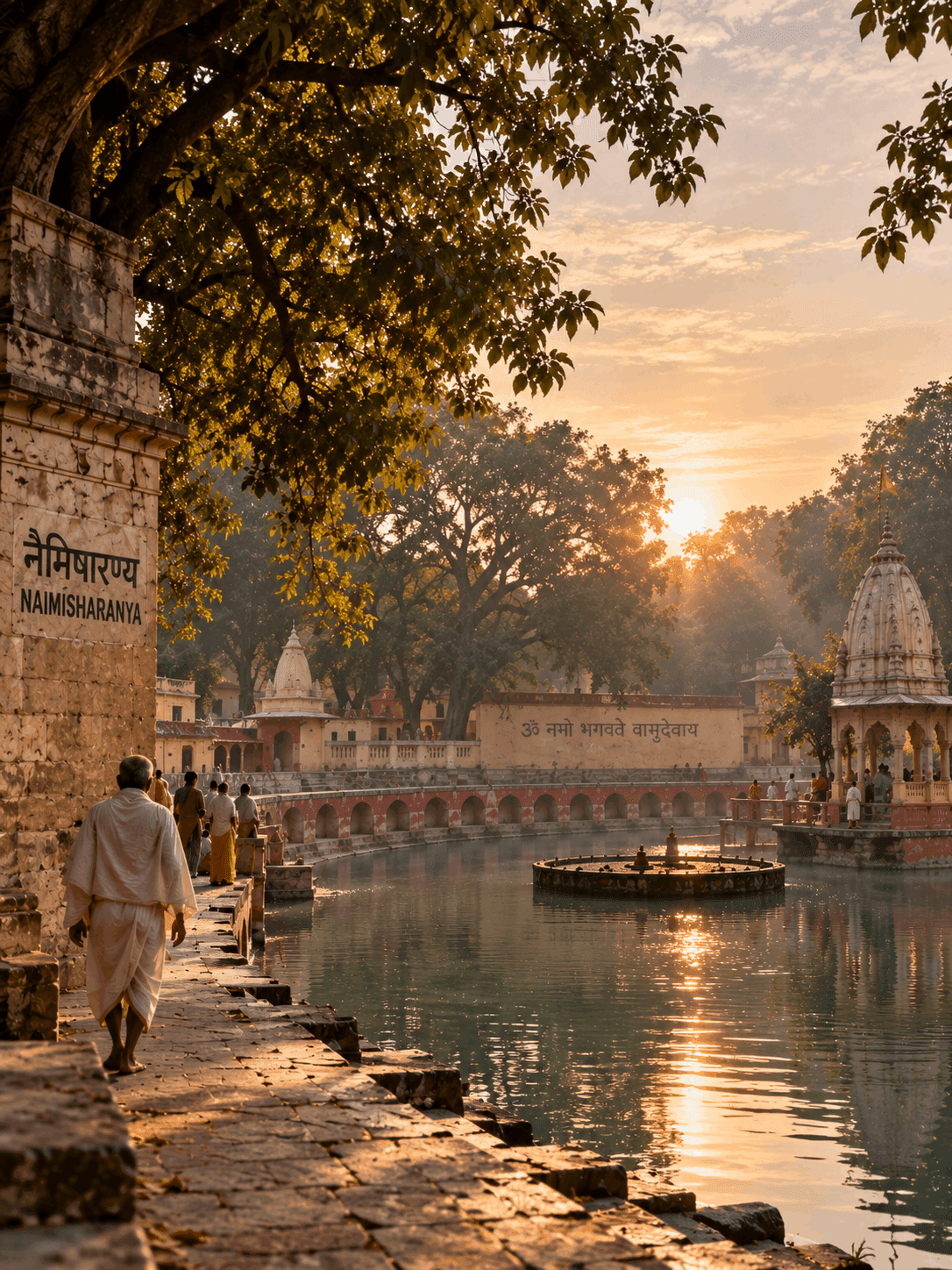
Naimisharanya, in Sitapur district, is held in tradition to be the forest where the sage Suta Goswami first recited the Puranas to an assembly of eighty-eight thousand sages. It remains one of Hindu tradition's oldest and most revered pilgrimage sites.
A StayNaut journey here is built around Chakratirtha and the Lalita Devi Temple, with time for the quieter ashrams and tirthas spread across the town.
Many travellers come to Naimisharanya to perform ancestral rites, drawn by its reputation as a place where such offerings carry particular merit. Others come as part of a wider Ramayana journey, or simply for the stillness of a pilgrimage site that has stayed relatively uncommercialised.
Spiritual significance
What makes Naimisharanya sacred.
Naimisharanya is described in the Puranas as the site where Lord Brahma's discus (chakra) struck the earth, creating Chakratirtha — regarded as the centre of the universe in Puranic cosmology, and the spot from which the sages are said to have never departed.
Lalita Devi, the presiding deity, is worshipped as one of the 51 Shakti Peethas of Hindu tradition. Naimisharanya's connection to the Vedas and Puranas also runs through Vyas Gaddi, where Ved Vyas is traditionally held to have compiled the four Vedas and eighteen Puranas.
Important sites
Places worth your time.
Chakratirtha
The holiest site in Naimisharanya, marking where Brahma's discus struck the earth; pilgrims bathe here and make offerings to Lalita Devi.
Lalita Devi Temple
The temple of the presiding deity of Naimisharanya, one of the 51 Shakti Peethas, a short walk from Chakratirtha.
Vyas Gaddi
The site where Ved Vyas is traditionally held to have compiled the Vedas and Puranas, near Chakratirtha.
Hanuman Garhi
A temple linked to a Ramayana episode of Hanuman's emergence here after his battle with Ahiravana in Patal Lok.
What StayNaut arranges
What a Naimisharanya journey can include.
Naimisharanya is usually visited over a single unhurried day, often as part of a longer Ramayana-linked route between Lucknow, Ayodhya, and Prayagraj.
- Darshan and a ritual bath at Chakratirtha
- Visits to Lalita Devi Temple, Vyas Gaddi, and Hanuman Garhi
- Arrangement of ancestral rites with priests StayNaut works with locally
- Onward travel arranged to Ayodhya or Lucknow
Good to know
Practical considerations.
- Naimisharanya is a small town with limited accommodation — StayNaut maintains a journey office here and plans stays accordingly.
- The site is quieter and less developed than Kashi or Ayodhya, with a more contemplative, unhurried atmosphere.
- As with any rites you're hoping to perform, it helps to tell us in advance so timing and priests can be arranged properly.
Who this may suit
Is this the right journey for you?
- Travellers seeking a quieter, less crowded pilgrimage experience
- Families performing ancestral rites
- Pilgrims tracing a wider route through Ayodhya, Lucknow, and Prayagraj
Common questions
About the Naimisharanya journey.
What is Naimisharanya known for?
It's held to be where the Puranas were first recited by the sage Suta Goswami, and where Brahma's discus struck the earth at Chakratirtha. It's also one of the 51 Shakti Peethas, through the Lalita Devi Temple.
Is Naimisharanya suitable as a standalone trip?
It can be, but most travellers combine it with Ayodhya or Lucknow, given its smaller size and limited standalone accommodation. StayNaut maintains a journey office here to support exactly this kind of route.
Can rites be arranged here?
Yes — Naimisharanya is a common site for ancestral rites. Let us know what you're hoping to perform when you start planning, so we can arrange timing and priests properly.
Start your journey
Your Pilgrimage.
Completely Arranged.
Tell us where you’re thinking of going, who you’re travelling with, or simply what brings you there. We’ll take it from there.
Thoughtfully planned. Personally managed.